Starting and managing a business as a sole proprietor is one of the easiest ways to turn an idea into reality. However, as your sales grow, staying compliant with Indian tax laws becomes essential. A key step in this journey is securing your Goods and Services Tax (GST) registration.
Whether you run a local retail store, sell online, or offer freelance services, understanding how gst registration for sole proprietorship works helps you protect your business, build client trust, and avoid government fines.
In this easy-to-understand guide, we break down everything you need to know about registration for proprietorship, threshold limits, mandatory rules, step-by-step application steps, and the exact list of documents required for gst registration for proprietor.
What is a Sole Proprietorship in GST?
A sole proprietorship is a business owned and managed by a single person. In the eyes of the law, there is no separate legal distinction between the owner and the business.
Because the business does not have its own separate PAN card, the registration for proprietorship under GST is issued directly against the personal Permanent Account Number (PAN) of the owner.
Do You Need GST Registration for Proprietorship?
Not every small business needs to apply for GST on day one. The government provides annual turnover exemption limits depending on the nature of your business and where you operate.
1. Turnover Limits (Threshold Exemption)
- Goods Suppliers: If your total annual sales exceed ₹40 Lakhs (₹20 Lakhs in special category North-Eastern and hill states), GST registration is mandatory.
- Service Providers: If your total annual billing exceeds ₹20 Lakhs (₹10 Lakhs in special category states), GST registration is mandatory.
2. Mandatory GST Registration (Regardless of Turnover)
You must register for GST even if your sales are zero if you fall into any of these categories:
- Inter-State Traders: Selling goods or services across state borders.
- E-Commerce Sellers: Selling products through platforms like Amazon, Flipkart, or Meesho.
- Casual Taxable Persons: Setting up temporary stalls or pop-up shops in another state.
- Reverse Charge Mechanism (RCM): Paying taxes on specific goods or services under RCM rules.
Pro Tip: If your turnover is below the limit, you can still opt for voluntary registration on our GST Registration Page. Voluntary registration allows you to issue valid tax invoices, claim Input Tax Credit (ITC) on purchases, and do business with larger corporate clients.
Documents Required for GST Registration for Proprietor
Before starting your application on the government portal, keep all your paperwork ready. Preparing these files in advance prevents application rejections or delays caused by clarification notices from tax officers.
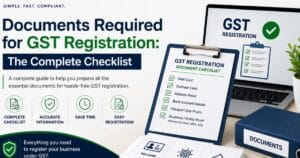
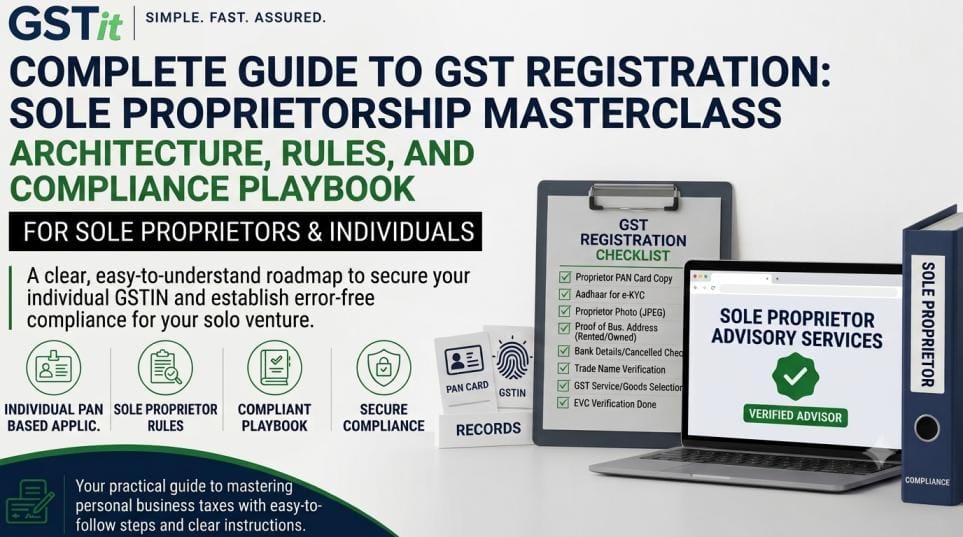
Here is the complete checklist of documents required for gst registration for proprietor:
1. Identity & Address Proof of the Owner
- PAN Card of the Proprietor: Mandatory primary document used as the base for registration.
- Aadhaar Card: Mandatory for online Aadhaar authentication and quick e-KYC approval.
- Passport Photo: Clear passport-size photograph of the proprietor in JPEG format (under 100 KB).
2. Proof of Principal Place of Business
Depending on where you run your business from, submit the appropriate address proof:
- If Owned Premises: Property tax receipt, municipal khata copy, electricity bill, or water bill in the owner’s name.
- If Rented or Leased Premises: Valid Rent/Lease Agreement along with a recent utility bill (electricity bill) of the landlord.
- If Shared / Shared Family Property: A signed No-Objection Certificate (NOC) or consent letter from the property owner, plus their electricity bill.
3. Bank Details
- A cancelled cheque with the proprietor’s name printed on it, the first page of the bank passbook, or a recent bank statement.
You do not need a bank account on day one to apply for GST. You can complete your registration first using your PAN, Aadhaar, and Address Proof. Once your GST certificate is generated, you have 30 days to open/link your account and upload a cancelled cheque, passbook copy, or bank statement under a simple Non-Core Amendment on the GST portal.
4. Business Verification / License (Optional but Recommended)
- Shop and Establishment Certificate, MSME / Udyam Registration, or Trade License showing the business trade name.
For a detailed walkthrough of documents across all business types, read our in-depth post on Documents required for GST registration.
Overview of Documents Required
| Category | Primary Required Document | Accepted Alternatives / Additional Documents |
|---|---|---|
| Owner Identity | Proprietor PAN Card | Aadhaar Card, Passport Photo |
| Business Address | Rent Agreement + Electricity Bill | Property Tax Receipt, NOC Consent Letter |
| Bank Verification | Cancelled Cheque | Passbook Front Page, Bank Statement |
| Business Name Proof | Udyam / MSME Certificate | Shop & Establishment License, Trade License |
Step-by-Step Process for Sole Proprietorship GST Registration
The process for gst registration for sole proprietorship is entirely online. Here is a clear breakdown of the application steps:
Step 1: Create a Temporary Reference Number (TRN)
- Go to the official GST portal (
www.gst.gov.in).
- Go to the official GST portal (
- Click on Services > Registration > New Registration.
- Select Taxpayer and choose your State and District.
- Enter your Business Legal Name (must match your PAN card) and personal PAN.
- Enter your email ID and mobile number. Submit the OTPs sent to your mobile and email to generate a 15-digit Temporary Reference Number (TRN).
Step 2: Complete the Application Form (Part-B)
- Log in to the GST portal using your TRN.
- Fill out Part-B of the form, which includes:
- Business Details: Enter your Trade Name (your brand name).
- Proprietor Details: Personal information, address, and upload your photo.
- Principal Place of Business: Enter address details and upload business address proof.
- Goods & Services (HSN / SAC codes): Select the top goods or services you sell.
- Fill out Part-B of the form, which includes:
Step 3: Complete Aadhaar Authentication
Select the Aadhaar Authentication option. An authentication link will be sent to the mobile number registered with your Aadhaar. Completing e-KYC speeds up approval and reduces the chances of a physical site inspection.
Step 4: Verification and ARN Generation
Submit your form using an Electronic Verification Code (EVC) sent to your mobile number. Once submitted, an Application Reference Number (ARN) is issued to track your application.
Step 5: Approval and GST Certificate Download
The tax officer reviews your application. If all details match, your GST registration will be approved within 3 to 7 working days. You can then log into the GST portal and download your official 15-digit GSTIN Registration Certificate (Form GST REG-06).
Benefits of GST Registration for Sole Proprietors
- Legal Recognition: Makes your sole proprietorship an officially recognized business entity across India.
- Input Tax Credit (ITC): You can claim back the GST paid on purchases, raw materials, machinery, and business expenses.
- Pan-India Expansion: Allows you to sell products on e-commerce sites like Amazon, Flipkart, or your own website.
- Corporate Client Approval: Large companies require a valid GSTIN to process payments and vendor onboardings.
- Easier Banking: Having a GST certificate makes opening a business current bank account effortless.
Common Mistakes to Avoid During Application
- Name Mismatch: Entering a trade name that does not match your uploaded documents or PAN card.
- Unclear Address Proof: Uploading blurry, old, or partial utility bills (bills should be recent and clearly display the address).
- Missing Consent Letters: Not providing an NOC when operating from family-owned or shared premises.
- Incorrect File Formats: Uploading files that exceed size limits or are in unaccepted file formats.
If you need professional assistance to avoid delays, apply hassle-free through our dedicated GST Registration Page.
Frequently Asked Questions (FAQs)
1. Is PAN mandatory for GST registration of a sole proprietorship?
Yes, PAN is mandatory. Since a sole proprietorship does not have a separate entity PAN, the owner’s personal PAN is used.
2. Can I use my home address for GST registration?
Yes, you can use your home address as your principal place of business. You will need to provide an electricity bill, property tax receipt, or an NOC if the property is owned by a family member.
3. How long does GST registration take for a sole proprietor?
If your documents are accurate and you complete Aadhaar authentication, approval usually takes between 3 to 7 working days.
4. What are the government fees for GST registration?
The government charges zero fee for issuing a GST registration certificate.
Final Thoughts
Obtaining your gst registration for sole proprietorship is a critical milestone that opens doors to new growth, wider customer reach, and full legal compliance. By gathering all documents required for gst registration for proprietor beforehand, you can complete the online process smoothly without rejections or delays.
Ready to get started? Visit our GST Registration Page for expert guidance, or explore our detailed post on Documents required for GST registration to double-check your paperwork!